When Nowruz falls
Nowruz 2027: Saturday 20 March, the first day of Farvardin, beginning the year 1406.
The date moves because Nowruz is astronomical rather than calendrical. It begins at the March equinox — the instant the sun crosses the celestial equator — which falls on 19, 20 or 21 March depending on the year and on where you are. The Iranian solar calendar is built around that moment, which is why it never drifts out of season the way a purely conventional calendar would.
The exact instant is called the tahvil (تحویل), the “turning.” It can land at four in the morning or halfway through lunch, and it does not matter: families arrange themselves around the Haft-Sin table to be together when it passes. Iranian television broadcasts a countdown. Someone always cries.
You will see it written Nowruz, Norouz, Norooz or Nawruz, and called the Persian New Year or Iranian New Year. All the same day.
What Nowruz is
Now-ruz (نوروز) means literally “new day.” It is more than three thousand years old, with roots in Zoroastrian Iran, and it survived the arrival of Islam, a dozen dynasties and a revolution largely intact — which tells you something about how deep it sits.
It is not a religious holiday. It is kept by Muslims, Zoroastrians, Jews, Christians, Bahá’ís and the entirely secular, and it stretches well beyond Iran: Afghanistan, Tajikistan, Azerbaijan, Kurdistan, Uzbekistan, parts of India and Pakistan, and every diaspora community descended from them. UNESCO lists Nowruz on its Representative List of the Intangible Cultural Heritage of Humanity, and the United Nations named 21 March the International Day of Nowruz.
The preparation is half the holiday. Khaneh-tekani (خانهتکانی), literally “shaking the house,” is a deep spring clean that starts weeks ahead: curtains washed, carpets beaten, everything turned out. New clothes are bought to be worn on the first day. The idea is that you meet the new year clean and new, and not carrying last year in with you.
The Haft-Sin table, item by item
Haft-Sin (هفتسین) means “seven S’s.” It is the centrepiece of the house for the whole holiday: a spread of seven items whose Persian names begin with the letter sin (س), each standing for something wished on the year.
- Sabzeh (سبزه) — wheat, lentil or barley sprouts grown in a dish, started a couple of weeks early so they are green by the equinox. Rebirth.
- Samanu (سمنو) — a thick sweet pudding made from germinated wheat, cooked slowly and traditionally by a group of women overnight. Strength and affluence.
- Senjed (سنجد) — dried oleaster, the silverberry. Love.
- Seer (سیر) — garlic. Health and medicine.
- Seeb (سیب) — apple. Beauty and health.
- Somaq (سماق) — sumac, for the colour of sunrise.
- Serkeh (سرکه) — vinegar. Age and patience.
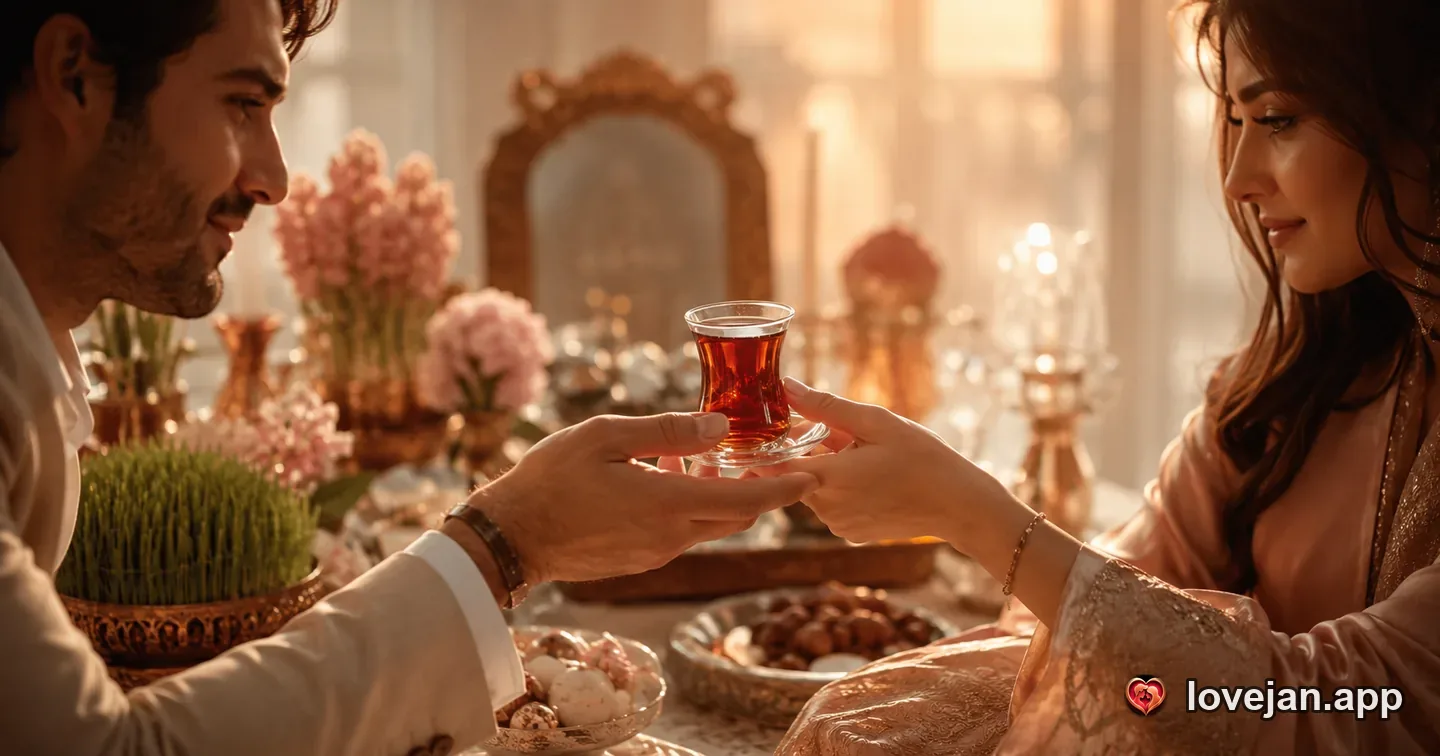
Then there is everything else on the table that does not start with S and is there anyway: a mirror and candles for light, painted eggs often one per family member, coins for prosperity, hyacinth for spring’s scent, a bowl of water, and a book — the Quran, or the Divan of Hafez, or the Shahnameh, depending on the household. Goldfish are traditional and increasingly skipped, since a great many families have decided that a living animal bought as a decoration is not the way they want to start a year.
No two Haft-Sin tables look alike, and elaborate ones have become their own quiet competition among relatives.
Chaharshanbe Suri: the fire before the new year
On the eve of the last Wednesday before Nowruz comes Chaharshanbe Suri (چهارشنبهسوری), the fire festival. Small bonfires are lit in streets and gardens and people jump over them, calling:
سرخی تو از من، زردی من از تو
sorkhi-ye to az man, zardi-ye man az to
“Your redness to me, my paleness to you.”
You are asking the fire for its health and colour and handing it your winter pallor and sickness in return. It is a straight trade with a flame, and it is thousands of years old. The night is loud, a little chaotic, and in modern Iran involves rather more fireworks than the tradition strictly requires.
The thirteen days, and Sizdah Bedar
Nowruz is not a day, it is a thirteen-day holiday. The first days are for eyd didani, new-year visits, and the order matters: the young call on the old first, and the newly married are visited rather than visiting. Children and unmarried young people receive eydi (عیدی), a small gift of money, often crisp new notes tucked inside a Quran or a book of Hafez.
The holiday ends on the thirteenth day with Sizdah Bedar (سیزدهبدر), which lands in the first days of April. Everyone goes outdoors — parks, riversides, anywhere green — because to stay inside on the thirteenth day is asking for trouble. The sabzeh that has been growing on the table since before the new year is thrown into running water, carrying the household’s bad luck away with it.
And there is a detail that belongs on this site: on Sizdah Bedar, unmarried people tie knots in blades of grass while making a wish about finding someone. Untying it, the saying goes, is the next person’s job.
How to say happy Nowruz
- Nowruz mobarak — نوروز مبارک — “happy Nowruz.” The standard, and never wrong.
- Nowruz pirooz — نوروز پیروز — older and warmer, roughly “may your Nowruz be victorious.”
- Sal-e no mobarak — سال نو مبارک — “happy new year.”
- Eyd-e shoma mobarak — عید شما مبارک — “may your holiday be blessed,” the more formal one to use with elders.
If you are texting one specific person rather than a group, Nowruz-et mobarak is the singular form and lands more personally. More of this in our guides to saying “I love you” in Persian and Persian terms of endearment.
Nowruz in the diaspora
In Tehrangeles, Nowruz fills parks from the San Fernando Valley to Orange County every March, and Persian markets in Westwood stock sabzeh, sumac and hyacinth for weeks beforehand. Public Nowruz festivals, university Persian student associations and community centres all run events, and they are among the easiest doors into Iranian culture for someone who did not grow up in it — there is food, there is music, and nobody expects you to know the choreography.
The most common diaspora adaptation is timing. The tahvil lands whenever it lands, and a Tuesday 3 a.m. equinox does not fit around American school runs, so many families mark the moment quietly and hold the real gathering on the nearest weekend. Nobody considers this cheating.
Starting a new year on your own
Nowruz is a family holiday, and family holidays are the ones that ask the loudest questions. Thirteen days of visits, thirteen days of relatives, and somewhere around day three, someone asks when it is your turn.
If you would rather answer that question differently next March, LoveJan is a dating app built for Persian and Iranian singles: profiles need verification approval to appear in Discover before they can appear in Discover, your photos can stay private until you match, and matching and messaging are free. The Persian Dating Guide covers the culture, Yalda Night covers the other end of the calendar, and Persian wedding traditions covers where some of this ends up.
A different kind of new year.
Meet verified Persian & Iranian singles — download LoveJan free on the App Store or Google Play and get verified in minutes.
Frequently asked questions
When is Nowruz 2027?
Saturday 20 March 2027, beginning the Iranian year 1406. Nowruz starts at the exact moment of the March equinox rather than at midnight, so the new year can arrive at any hour. That moment is the tahvil, and families gather at the Haft-Sin table to be together when it passes.
Why does the date of Nowruz change?
It is astronomical, not calendrical. Nowruz begins at the March equinox, which lands on 19, 20 or 21 March depending on the year and your time zone. The Iranian solar calendar is built around that instant, which is why it stays locked to the seasons.
What is the Haft-Sin table?
“Seven S’s” — the Nowruz spread of seven items whose Persian names start with sin: sabzeh (sprouts) for rebirth, samanu (wheat pudding) for strength, senjed (dried oleaster) for love, seer (garlic) for health, seeb (apple) for beauty, somaq (sumac) for sunrise, serkeh (vinegar) for patience. Mirrors, candles, painted eggs, coins, hyacinth and a book of poetry usually join them.
What is Chaharshanbe Suri?
The fire festival on the eve of the last Wednesday before Nowruz. People jump over small bonfires calling sorkhi-ye to az man, zardi-ye man az to — “your redness to me, my paleness to you” — trading their winter pallor for the fire’s vitality.
What is Sizdah Bedar?
The thirteenth and last day of Nowruz, in the first days of April. Everyone picnics outdoors, and the sabzeh from the Haft-Sin table is thrown into running water to carry the year’s bad luck away. Unmarried people tie knots in grass and make a wish.
How do you say happy Nowruz in Persian?
Nowruz mobarak (نوروز مبارک). Warmer: Nowruz pirooz (نوروز پیروز). For a new-year wish: Sal-e no mobarak.
How long does Nowruz last?
Thirteen days, ending with Sizdah Bedar. The first days are for visits — the young call on the old first — and children receive eydi, a small gift of money.
Is Nowruz religious?
No. It predates Islam and has Zoroastrian roots, but it is kept as a cultural new year across every faith and none, from Iran and Afghanistan to Tajikistan, Azerbaijan, Kurdistan and the diaspora. UNESCO lists it as intangible cultural heritage, and the UN named 21 March the International Day of Nowruz.
Yalda Night → · Persian wedding traditions → · The Persian Dating Guide →